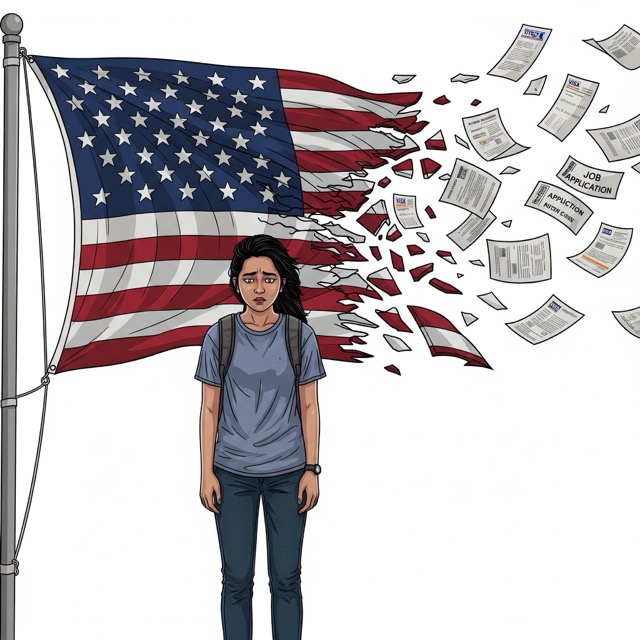
“Priyal, be honest,” a father asked me recently. “With Trump’s talk of stricter immigration, visas being revoked, and tuition going up every year — should we even send our child to the U.S. anymore?”
It’s a question I’ve been hearing more than ever this year. For decades, the United States was the default dream destination for Indian students — a place where the world’s best and brightest went to study, innovate, and launch global careers. But in 2025, the story feels different. The numbers alone are enough to rattle anyone: according to U.S. immigration data cited by Forbes, the number of international students arriving in the U.S. dropped by 50% in July 2025 compared to the same time last year — just 76,519 students versus 106,993 in July 2024. For Indian students, the fall was equally sharp, with arrivals halved. This is especially striking given that only last year, India became the largest source of international students in the U.S. with 332,000 enrolled in 2023–24, a record 35% year-on-year growth (Open Doors 2024). Experts now predict that new student enrollments may decline by 50% in Fall 2025.
So yes — the anxiety isn’t imagined. It’s real.
What’s fueling the uncertainty?

- Visa volatility. The U.S. suspended F-1 visa interviews earlier this year, creating bottlenecks. More than 1,000 student visas — many held by Indians — were suddenly revoked for “minor infractions” (Financial Express, BBC). Students have even been warned they could lose visas if they miss classes or paperwork deadlines.
- OPT in question. A new bill in Congress seeks to eliminate the Optional Practical Training (OPT) program, which currently gives international graduates up to three years of work authorization in the U.S. for STEM fields. That’s a major source of stress for families thinking long-term.
- H-1B reforms. The USCIS “beneficiary-centric” rule (Dec 2024) now requires that an H-1B job be directly related to a student’s degree. This has raised questions for those hoping to work in flexible or interdisciplinary roles.
- Shifting campus climate. The 2023 Supreme Court ruling in Students for Fair Admissions v. Harvard ended race-conscious admissions. Combined with laws like Florida’s SB 266 and Texas’s SB 17, which restrict or eliminate DEI offices in public universities, students worry about whether campuses will feel less inclusive.
- Cost pressures. The average cost of attendance in 2024–25 is $49K at public universities (out-of-state) and $63K at private institutions (College Board). Rising inflation and tariffs on imported technology and lab equipment may push costs even higher.
What families should and shouldn’t worry about
Here’s where I often pause families: not all fears are equally real.
- Real issues to plan for:
- Visa interview preparation matters — denial rates hit 41% globally in 2024 (up from 36% in 2023, U.S. State Dept data). Please sanitize and share all your social media footprint.
- H-1B is more competitive and narrower in eligibility.
- The financial burden is heavier; ROI planning is essential.
- Exaggerated fears:
- OPT hasn’t been revoked. The STEM OPT 24-month extension (up to 36 months total) is still intact.
- Universities are not shutting doors — they remain reliant on international students for diversity, revenue, and research talent. The U.S. still hosts 1.16M+ international students (Open Doors 2024).
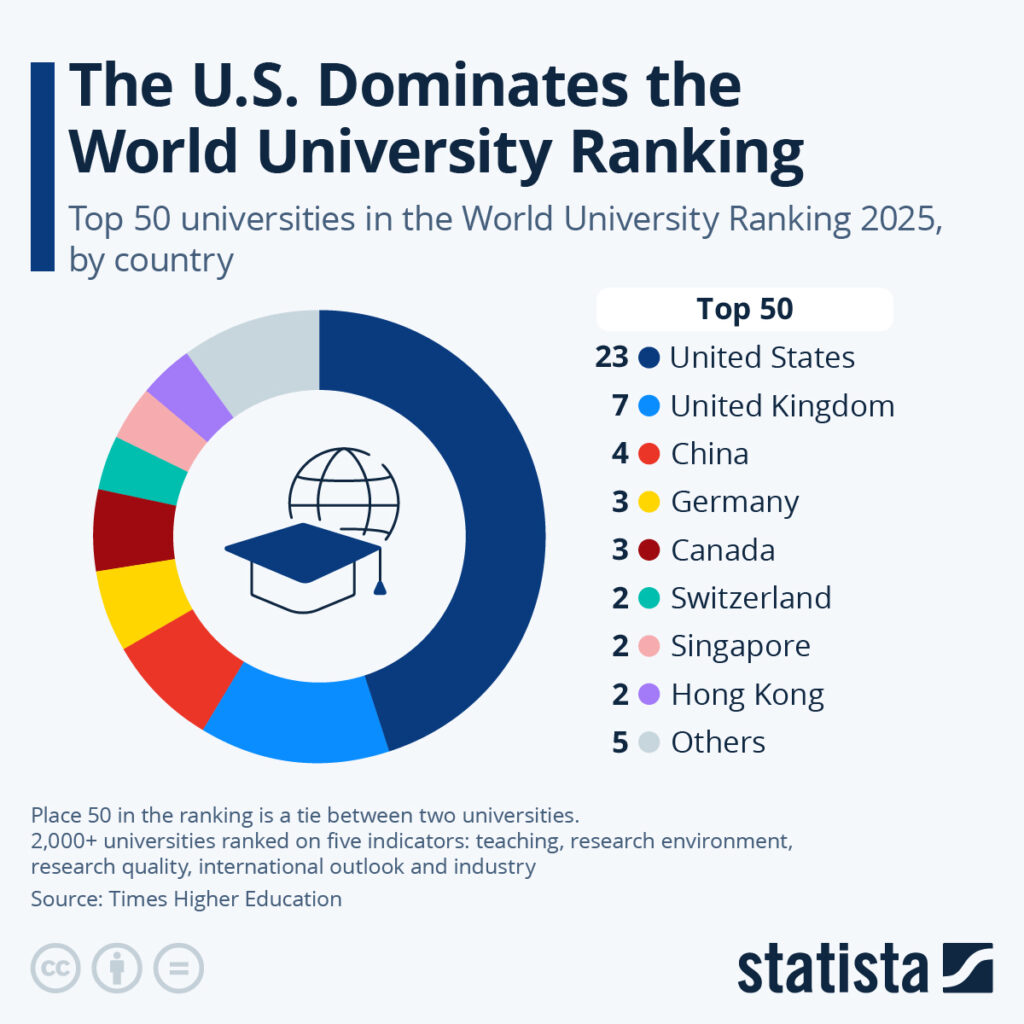
- Despite policy turbulence, the U.S. dominates global education: 7 of the world’s top 10 universities, 38 of the top 100, and 55 of the top 200 are American (Times Higher Education 2025).
Why the U.S. Still Delivers ROI
The return on investment in a U.S. education has never been only about salaries. Yes, the numbers matter — average starting salaries for U.S. STEM and business graduates often exceed $70K–$100K+. But the U.S. also offers:
- 🌍 Global brand recognition: A U.S. degree still signals academic excellence worldwide.
- 🔬 Research & innovation hubs: From Silicon Valley to the Ivy League, students access labs, incubators, and funding like nowhere else.
- 🤝 Alumni networks: Indian graduates join some of the most influential professional networks globally, opening doors in business, policy, tech, and creative industries.
- 📚 Flexibility of curriculum: Unlike the UK or India, U.S. education allows students to explore multiple fields — from economics to film, from engineering to design — before committing. That freedom to pivot is invaluable in an age of rapid industry shifts.
- 🌱 Resilience & adaptability: Living and studying in the U.S. equips students to navigate uncertainty — a skill that’s increasingly essential in today’s volatile world.

So… Should You Still Apply?
Here’s my take: don’t abandon the U.S. — but don’t put all your eggs in one basket either.
Yes, be realistic about the challenges:
- Build a financial plan early.
- Take visa preparation seriously.
- Understand H-1B and alternative pathways (STEM OPT, O-1A for “extraordinary ability,” L-1 for intra-company transfer, or EU/UK post-study visas if you need a Plan B).
At the same time, remember the U.S. remains a global leader in higher education, innovation, and opportunity. If your child’s goals align with its strengths, the investment can still pay off — but strategy, resilience, and diversification are the keys in 2025.
✨ At NorthStar Education, we help families cut through fear, decode policy changes, and build global admissions strategies. The U.S. is still powerful — but it’s no longer about chasing prestige. It’s about choosing the right fit, ensuring ROI, and preparing for every scenario